Color coding is a great way to prioritize and understand your schedule in a single quick look because our brains process visual information faster than text. When tasks start piling up, it’s easy to feel overwhelmed, but using different colors can help bring structure to your day. Here’s how to color code your tasks to increase productivity and quickly win the day.
Prioritize your schedule
Before you start color coding your tasks, you need to know how to create a prioritized schedule. Make a todo list, and figure out the important tasks, those that will make the most impact or bounded by time. Sort them by Critical, High, Medium, and Low priorities and set a realistic deadline for every task. Now after you have it all, you’re ready to begin color coding it.
Use color psychology
Knowing how colors affect our psychology makes it easier to assign the right color to tasks and keep the schedule organized. The main idea is to make sure colors work specifically for your needs. You can always use your own meaning for colors. Specifying color to a task will set it apart from others and put your focus on the right things. Go over the list of colors below to learn more about which colors evoke a certain feeling and how you can use them to your advantage.
Red
Red is the color of energy, passion, and action. It’s bold and catchy, so it’s perfectly suited to be used as a color to catch our attention. Use it for any important tasks that you want to emphasize to the maximum, tasks that you would want to get done first.

Blue
Blue is the color of trust, responsibility, honesty, and loyalty. The best practice is to reserve it for more calm and relaxed tasks, it’s not drawing too much attention to save it for the tasks that you enjoy doing. This can help you get into the mindset of knowing when to take a break and recharge.

White
The color white often represents purity, and new beginnings, like a clean canvas before drawing. One great way to use white is for tasks that you haven’t planned yet. In most apps that’s the default color of any new task, so you can keep the default white to highlight the tasks that aren’t fully planned.

Grey
Grey is often described as being a bland and unemotional color. But sometimes that’s exactly what we need. The grey color could be used for tasks that have a very low priority. For example, if you’re out of red tasks it could be a convenient time to focus on the non-essential grey tasks.

Purple
Purple relates to imagination, mystery, and spirituality. It makes a lot of sense to use it for tasks of a similar nature since purple is the combination of red and blue, and your creative tasks may also be of high priority and require you to feel relaxed, as for red and blue. Purple can also highlight tasks that require you to have a deep concentration session.

Green
Green is a color with balance and harmony. You can use green to apply to health or fitness-based tasks. Although it may not be as bold as red, it is still noticeable enough to remind you of why you should get certain tasks done. Whether it refers to health or other fitness activity, green is perfect to keep your attention fixed on the crucial areas of life.

Yellow
Yellow is a color that tends to evoke feelings of happiness, joy, and excitement. Many also consider it as a color that relates to acquired knowledge. Use yellow for items that happen less often but excite you and give you happiness.

Color coding across every area of life
Work & productivity
- Assign colors to clients or projects
- Differentiate meetings, deadlines, and deep-focus blocks
- Highlight urgent items in red for instant attention
Personal life
- Color-code chores by family member
- Separate birthdays, appointments, and social events
- Plan meals by food group for balanced nutrition
Health & wellness
- Track workouts by type: strength, cardio, yoga
- Use a habit tracker with color to show progress
- Tag self-care activities to keep routines balanced
Physical tools that work
Digital tools are convenient, but analog methods add a tactile layer to your system. A few that pair well with any color strategy:
Sticky notes
Yellow for brainstorming, blue for scheduled meetings, red for urgent deadlines, green for completed tasks or progress milestones.
Multicolored pens & notebooks
Writing in different colors helps separate key details, red for deadlines, green for action items, blue for general notes and meeting summaries.
Washi tape & colored tabs
Mark important sections in notebooks or planners and visually separate projects or chapters, an easy way to make organization tactile and satisfying.
Whiteboards
For a big-picture view, a whiteboard with colored markers lets you organize schedule, tasks, and ideas in one shared space, great for teams and households alike.

Color-coded workspaces
Extending color coding to your physical environment makes organization second nature:
- Filing systems: use colored folders by topic or project, labeled with matching stickers so documents are always findable without searching.
- Task trays: blue for incoming, yellow for in-progress, green for complete, red for urgent. A simple visual workflow for paper-heavy work.
- Storage & cables: color-coded bins for supplies and colored cable ties for devices saves time and frustration when you need something quickly.
How Planndu makes this effortless
Planndu is a personal task manager and daily organizer built around this kind of structured thinking. Its color system lets you assign colors to task categories and change colors as tasks progress. To color code in Planndu, click on the Change Colors icon on new task screen and select your preferred color.
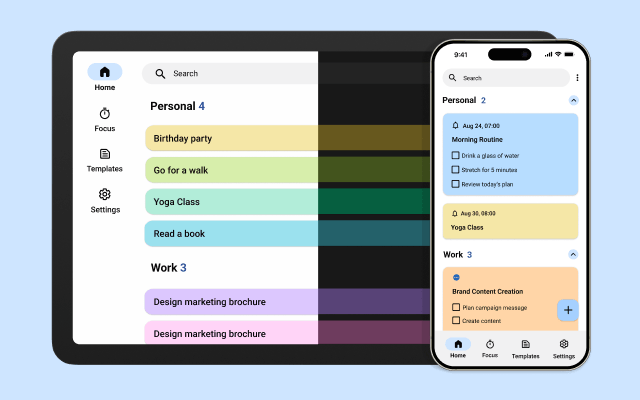
Color coding isn’t about making things look pretty, it’s a proven organizational strategy that reduces decision fatigue, improves focus, and make both work and personal life easier to manage. Start simple: pick two or three colors with clear meanings, apply them consistently for a week, and notice how much faster you move through your day.