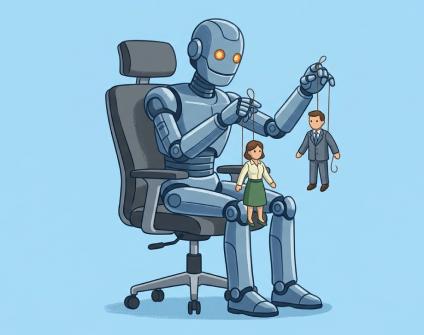
There’s a specific kind of exhaustion that has quietly crept into modern work, one that barely existed a few years ago. You open your laptop, fire up an AI assistant, and by 11 a.m. your project is suddenly filled with security issues, broken logic or in the worst cases, a deleted database.
And yet, instead of stepping away, you feel compelled to run just one more prompt. The AI already completed 80% of the work, so surely the next response will fix everything. Then another prompt. And another. Hours disappear as you spiral deeper into debugging, patching, regenerating, and trying to wrestle control back from the chaos. At some point, you realize you physically can’t stop until it somehow works.
Welcome to AI Brain Fry, the cognitive hangover of an era that promised to save us time, but instead began colonizing our attention in ways we’re only starting to understand.
AI tools can be effective when used intentionally. But when used carelessly, they quietly erode the mental muscles that made you effective in the first place. And now, the research is beginning to support what many professionals are already feeling firsthand.
The Problem Nobody Is Talking About
A recent study by researchers at Harvard found that certain patterns of AI use are directly linked to increased cognitive fatigue and burnout. The researchers described a phenomenon they called “Brain Fry”: a state of mental exhaustion that can intensify the more heavily people rely on AI for thinking and decision making.
Part of the problem is psychological. AI systems often create the feeling that you’re almost at the answer, close enough to keep refining, prompting, and checking endlessly. Instead of doing the actual work it can trap users in a loop of constant mental engagement and uncertainty.
When workers outsource higher level cognitive tasks like judgment calls, synthesis, strategic thinking, they don’t necessarily free up mental bandwidth. Instead, they create a new kind of strain: the continuous low grade effort of reviewing, validating, and second guessing output they didn’t produce themselves. Rather than replacing one cognitive load with none, AI can leave people carrying two at once: managing the system and managing their uncertainty about whether the result is actually correct.
Meanwhile, separate research from Stanford University on AI in professional environments found something equally counterintuitive: AI often doesn’t reduce work, it intensifies it. Researchers observed that AI integration frequently increases both the pace and volume of tasks workers are expected to complete. The cognitive burden on individuals often rises. You process more but you produce less.
And almost nobody stops to ask whether that pace is actually sustainable.

What Is AI Fatigue, Exactly?
Before we talk solutions, it’s worth naming the enemy clearly.
AI fatigue is emerging as a recognised psychosocial condition, a multidimensional form of burnout specific to AI-mediated work environments. It arises from the interplay of technostress (the pressure to continuously adapt to evolving tools), decision fatigue (the mental cost of evaluating outputs), and cognitive offloading gone wrong (the gradual erosion of confidence in your own thinking when you stop exercising it).
It has three distinct layers:
- Surface Fatigue: You’re tired of learning new AI tools every six weeks. The update cycle is relentless. Every platform adds a new feature, every workflow gets disrupted, and the cognitive cost of adaptation is real, even if invisible.
- Validation Fatigue: AI outputs require human review. But reviewing output you didn’t generate requires a specific kind of effortful attention, you’re simultaneously reading, fact checking, and rethinking someone else’s (or something else’s) work. Do this all day and you’re exhausted in ways that are hard to articulate.
- Identity Fatigue: This is the quiet one. The slow erosion of confidence in your own ideas, instincts, and judgment when you routinely bypass them in favour of a generated first draft. Over time, workers report feeling less capable, less creative, and strikingly less motivated to tackle hard problems independently.
That last one deserves its own section.

The Slippery Slope of Cognitive Delegation
Here’s a truth that productivity culture doesn’t like to say out loud: delegating your thinking is addictive.
Not metaphorically addictive. Behaviourally addictive, in the clinical sense, following the same dopamine reward loops that make social media, gambling, and yes, certain substances so hard to put down.
When you hand a hard problem to an AI and get a polished answer in seconds, your brain gets a hit of relief. The aversive tension of not knowing resolves. You feel productive. You move on. And crucially, you didn’t have to sit in the discomfort of working through something difficult.
Do that often enough, and your brain starts to expect that shortcut. Tolerating ambiguity gets harder. Sitting with an unsolved problem starts to feel unbearable. You reach for the AI not because the task requires it, but because your nervous system has learned that this is how discomfort ends.
This is a slippery slope that’s more insidious than most people admit. Unlike social media, which feels frivolous, AI-assisted work only feels like productivity. Your output metrics might even improve in the first minutes. But underneath, you’re progressively losing the capacity for the kind of deep, independent thinking that produces genuinely original work, good judgment under pressure, and real expertise over time.
The researchers call this skill atrophy through disuse. You could call it the slow disappearance of the thing that made you valuable.
The antidote isn’t to stop using AI. It’s to stay deliberate about what you delegate and to keep the hard stuff for yourself.

How to Use AI in a Responsible, Sustainable Way
Let’s get practical. The goal is staying in charge of your own thinking while using AI as a genuine tool.
1. Think First. Polish Second.
This is the single most important principle: do your own thinking before you involve AI.
Draft your email. Sketch your argument. Write out your reasoning in messy, unpolished form. Then and only then, use AI to clean up grammar, or check for gaps.
This sequence matters enormously. When you generate the thought first, the AI serves your cognition. When the AI generates the thought first, you serve the average thought of the internet for reviewing, validating, and subtly conforming your judgment to its framing.
The first approach builds skill. The second erodes it.
Practical example: Before asking AI to help you write a report, spend 15 minutes outlining your actual argument in bullet points. What do you think? What evidence do you find most compelling? What’s your conclusion? Then use AI to help with structure, language, and presentation.
2. Use AI for Research Aggregation, Not Analysis
AI is genuinely excellent at summarising large volumes of information quickly. It’s significantly less reliable at interpreting what that information means for your specific context.
Let AI do the legwork of gathering. Do the analysis yourself.
Practical example: “Find me ten recent case studies on remote team management” is a great AI prompt. “Tell me what I should conclude from these case studies and how to structure my strategy” is a prompt that erodes your judgment.
3. Set No-AI Zones
Deliberately protect certain parts of your thinking from AI involvement. Keep some cognitive work fully your own, especially your private data, original ideas, long term strategies, and creative breakthroughs.
Consider keeping these human only:
- Your first response to any difficult decision
- Weekly planning and priority setting
- Strategic thinking about your career or long term goals
- Any communication that involves real relationship stakes
- Creative work where your voice is the point
These are exactly the areas where regular independent exercise of judgment keeps your thinking sharp.
4. Don’t Use AI When You’re Learning Something New
This one runs counter to the instinct of every overwhelmed person starting a new role or project. But using AI to shortcut the learning phase of acquiring a new skill or domain of knowledge is particularly costly.
The struggle of working through something unfamiliar is where encoding happens. Your brain builds the mental models you’ll need later. AI removes the productive friction that makes learning stick. Use it too early in a learning process and you’ll find yourself dependent forever, because you never built the foundation that would let you think independently.
Practical example: Learning to write better? Write your drafts without AI for a defined period. Use it to analyse your writing after your wrote it.
5. Time-Box Your AI Use
Treat AI like a meeting: useful in bounded doses, corrosive when unlimited.
Set a daily or per session limit on AI-assisted work. We still study the full picture and only begin to udnerstasnd the side effects of it, boundaries are how you stay in charge of any tool. If you find yourself defaulting to AI whenever a task feels even slightly uncomfortable, that’s the signal that the boundary needs tightening.
Key Productivity Principles to Keep You Sharp
Staying cognitively healthy in the AI era is a powerful advantage, one that will set you apart above almost everyone else. Here are the ones worth internalizing:
Discomfort is data, not a problem to solve. The feeling of not knowing how to approach something is the beginning of thinking, not a signal to outsource. Train yourself to stay in that space a little longer before reaching for a shortcut.
- Output ≠ value. In AI-assisted environments, volume of output is easy. The rarer and more valuable skill is judgment, knowing which output matters, which direction is right, and what a good decision looks like in context. Protect the capacity to exercise judgment.
- Rest is a productivity variable. AI fatigue is real fatigue. It responds to the same interventions: sleep, movement, boundaries between work and non work time, and regular periods where your brain is offline. Treating cognitive exhaustion as a problem to push through by generating more AI output is exactly backwards.
- Slow is smooth; smooth is fast. The most dangerous productivity trap is the illusion that speed is always better. Fast AI output followed by slow, careful human judgment often outperforms fast AI output followed by fast, uncritical acceptance.
- Your instincts are an asset. Use them or lose them. Expertise is largely pattern recognition, the accumulated residue of thousands of worked through problems. Every time you bypass your judgment in favour of AI output, you’re choosing not to reinforce that pattern recognition. Do it enough and the pattern starts to fade.
The Bottom Line
Don’t let anyone force you to use AI. I know it’s becoming common in companies, even though many are realizing it doesn’t fully deliver on its promise. They don’t necessarily care about your cognitive wellbeing, but you can think one step ahead about where this is going and how you can stay ahead of others even in these challenging times.
The workers and thinkers who will thrive in the next decade won’t be the ones who use AI the most, but those who maintain strong judgment and critical thinking skills. That means preserving the independent ability to know when AI helps and when it hinders. It means protecting the cognitive practices, deep work, deliberate practice, and rest that make you capable in the first place. And it means resisting, with discipline, the tempting comfort of offloading every difficult thought to a machine.
Your brain is the asset. AI is a tool. Use the tool to sharpen the asset, not replace it.
Want to stay sharp in the AI era? Start with one change: think first, polish second. For one week, write your first draft of every important piece of work without AI. Use it only at the end, for refinement. See what you notice.